

Jason Spilkin October 2026
MSGS and the End of the Dolan Discount
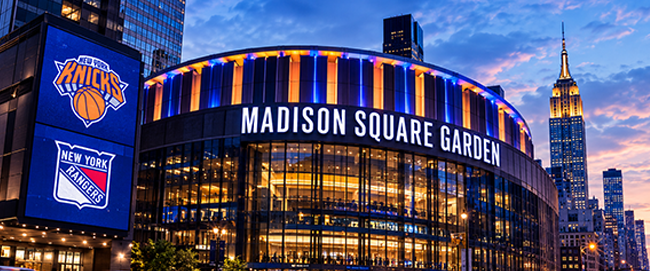
Madison Square Garden Sports (“MSGS”) is an unusual value investment. It owns two of the world's most coveted sporting assets, trades on a multiple of sales, generates little in the way of earnings and pays no dividend. On conventional metrics, it hardly looks cheap.
Yet the shares trade at a substantial discount to net asset value ('NAV'), which is primarily comprised of the New York Knicks basketball team and New York Rangers ice hockey team. This is less about earnings than the value of the underlying assets.
That may sound speculative, but the track record of American sports franchises suggests otherwise.
Consider the Dallas Cowboys. Jerry Jones bought the team for $140 million in 1989. Today it is worth almost $13 billion. That equates to an annual return of roughly 13%, comfortably ahead of the S&P 500 over the same period. What's remarkable is that investors achieved those returns despite relatively modest success on the field. The Cowboys have not won a Super Bowl since 1996.
Sports teams can offer attractive tax benefits too. Depending on the acquisition structure, buyers may be able to amortise acquired intangible assets and deduct certain business expenses. An S&P 500 ETF offers no such advantages. Nor does it provide a ticket to rub shoulders with the rich and famous.
That may help explain the attraction for billionaire investors such as Josh Kushner, (Jared's brother and the husband of Karlie Kloss) and former Disney CEO, Bob Iger, who recently agreed to acquire the Los Angeles Lakers at a record valuation of $12.5 billion.
The common denominator among the most valuable US sports franchises is not on-field performance. It is scarcity.
There are only so many teams. League expansion is tightly controlled. Meanwhile, demand for tickets, sponsorship, advertising and media rights continues to rise. Teams located in large and growing cities such as New York and Los Angeles are particularly well positioned. Demand keeps growing while supply barely changes.
The NBA is no longer just an American product. Stars such as LeBron James have become global celebrities, while franchises like the Lakers enjoy enormous international followings. China alone has hundreds of millions of basketball fans, creating an audience that many sports can only dream of.
Even in North Korea, Kim Jong Un is reportedly a Chicago Bulls fan and has hosted NBA legend Dennis Rodman on several occasions.
Media economics have become equally compelling. Streaming giants are now competing alongside traditional broadcasters for premium sports rights. The NBA's latest media rights agreements fetched almost three times that of a decade earlier, equating to a low teens annual percentage growth rate. Those windfalls ultimately flow through to franchise owners in the form of higher league revenues and distributions.
Against this backdrop, Madison Square Garden Sports should have been an easy winner. Yet until recently, the opposite was true.
Frustratingly, although the value of MSGS's underlying teams has grown at roughly 15% per annum over the past five years, the so-called 'Dolan discount' widened.
The discount persisted because investors could see no obvious catalyst to unlock value. James Dolan, CEO and controlling shareholder, has repeatedly stated that the teams were not for sale. Critics have long argued that he pays little attention to outside shareholders and prefers to run “his” businesses on his own terms.
There was similar scepticism when Dolan championed the construction of Sphere in Las Vegas. Many viewed it as an expensive vanity project. Cost overruns only added to those concerns.
The sceptics got that one wrong. Sphere turned out to be a highly successful investment.
Dolan remains one of the more colourful figures in corporate America. He is generously compensated for his part-time CEO role while simultaneously moonlighting as the lead vocalist and guitarist of his band, JD & The Straight Shot. His relationship with fans has often been strained, with several public disputes over the years reinforcing his reputation as one of professional sports' more controversial owners.
At the same time, our view has always been that MSGS belongs in the category Warren Buffett once described as 'idiot-proof' businesses.
After all, despite Dolan's comments, everything is for sale at the right price.
More importantly, actions often reveal more than words.
Over the past several years, Dolan has steadily simplified the corporate structure. The entertainment and sports assets were separated. Now the company is in the process of splitting the Knicks and Rangers into standalone businesses.
For years, investors argued there was no credible route to narrowing the discount. That argument is becoming harder to make.
In our view, it is difficult to interpret these actions as anything other than an attempt to unlock value. Management has publicly acknowledged that the share price fails to reflect the underlying value of the assets and has repeatedly refused to rule out a minority stake sale.
The timing may be particularly fortuitous. Following the Knicks' NBA championship victory this year, ending a fifty-three year title drought, enthusiasm around the franchise has rarely been higher.
Investors do not need Dolan to sell the Knicks to unlock value.
A minority stake sale could achieve much the same result. An investor buying at NAV, and likely at a premium, would receive the same tax advantages and social-status benefits described above. MSGS could use those proceeds to repurchase its own shares at a discount. Such a transaction would be highly accretive to NAV per share while allowing Dolan to retain control.
It is a simple idea. The question is whether Dolan wants to do it.
For years, MSGS shareholders have waited for a catalyst. Between the Knicks' championship run, management's renewed focus on value realisation and the ongoing corporate restructuring, that wait may finally be coming to an end.